Blog

  • ATS vs AI Screening: Key Differences Every Recruiter Should Know

    ATS vs AI Screening: Key Differences Every Recruiter Should Know

    If you’ve ever had a strong candidate tell you they applied for a role but never heard back – and you later found out they never made it through your screening system – you’ve experienced the most common and least discussed failure mode in modern recruitment.

    The candidate existed. The application arrived. The system filtered them out before a human ever saw their name.

    This is not always a technology failure. Sometimes it’s a misconfiguration, or a poorly written job description, or a mismatch between what the tool was built to do and what it’s being asked to do. But understanding why it happens – and how to prevent it – requires understanding the difference between two tools that most people treat as interchangeable: Applicant Tracking Systems and AI screening.

    They are not the same thing. They were not built for the same purpose. And using one to do the other’s job is where most of the problems in modern hiring pipelines originate.

    What an ATS actually is – and what it isn’t

    An Applicant Tracking System is, at its core, a workflow management tool. It was designed in the 1990s to solve a specific operational problem: large organisations receiving thousands of paper applications had no structured way to track who had applied, where each candidate was in the process, and what communications had been sent. The ATS digitised this – creating a centralised record of applications, pipeline stages, interview scheduling, offer management, and compliance documentation.

    This is what an ATS does well. It is genuinely excellent at managing the administrative lifecycle of a hire.

    What it was never designed to do – and what most ATS vendors would acknowledge if pressed – is evaluate whether a candidate is actually suitable for a role.

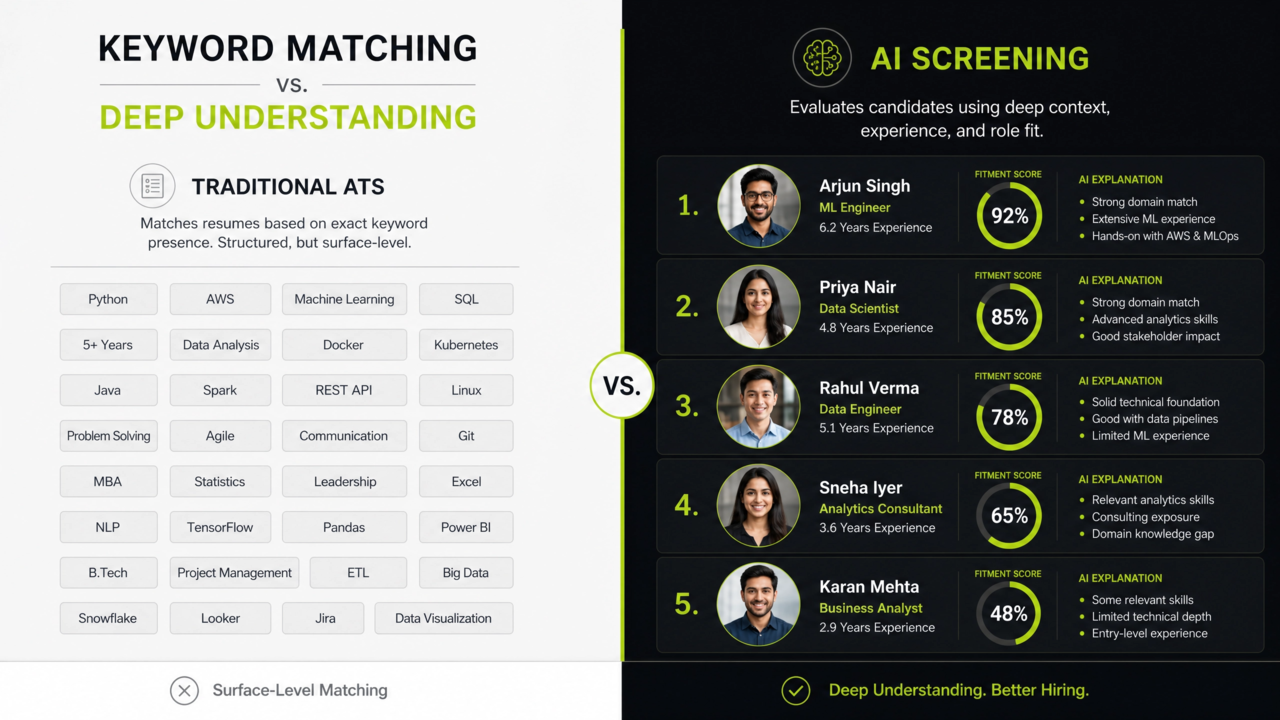
    “The ‘screening’ function that most ATS platforms offer is keyword matching: scanning resumes for the presence or absence of specific words or phrases from the job description.”

    If the JD says “project management” and the resume says “project management,” the candidate passes. If the resume says “led cross-functional delivery teams across six product launches,” the candidate may fail – even though they’ve demonstrated the same capability in richer language.

    This is not a minor technical limitation. It is a structural feature of how ATS systems were designed. They were built to sort and store, not to evaluate and interpret. Expecting an ATS to screen candidates with genuine intelligence is asking a filing cabinet to read the files.

    The scale of the problem

    The consequences of keyword-dependent screening are well-documented and significant.

    A landmark 2021 study by Harvard Business School and Accenture, titled Hidden Workers: Untapped Talent, surveyed over 8,000 workers and interviewed executives at 100 companies in the US, UK, and Germany.

    “The study found that automated screening tools were rejecting large numbers of qualified candidates – sometimes the majority of applicants for a given role – based on rigid keyword criteria that failed to capture actual competence.”

    The report coined the term “hidden workers” to describe the millions of qualified candidates systematically filtered out by automated screening tools before a human ever reviewed their application. The study estimated that in the US alone, there were up to 27 million such workers – capable, available, invisible to the systems designed to find them.

    A 2023 report by the Society for Human Resource Management (SHRM) found that 79% of recruiters reported their ATS was missing qualified candidates.

    The same report noted that 52% of talent acquisition professionals said identifying the right candidates from a large applicant pool was the hardest part of their job – a figure that suggests the tools supposed to solve this problem are, for many teams, making it worse.

    The irony is that the talent shortage most organisations claim to be experiencing may be partly self-inflicted. The candidates are applying. The systems are not finding them.

    What AI screening is – and how it actually works

    AI resume screening operates on a fundamentally different principle from keyword matching. Rather than scanning for the presence of specific words, it evaluates the semantic meaning of a document – what was actually done, not just how it was labelled.

    This distinction matters more than it might initially appear. Consider two candidates applying for a fintech product manager role.

    Candidate A has worked at three fintech companies, held the title of Product Manager at each, and uses all the expected vocabulary: roadmap, stakeholder management, agile, sprint planning.

    Candidate B spent five years at a logistics company building payment reconciliation systems for supplier networks, managing a cross-functional team of eight, and owning the full delivery lifecycle for a platform used by 400 enterprise clients.

    A keyword-matching ATS will almost certainly surface Candidate A and miss Candidate B – because Candidate B’s resume doesn’t contain “fintech” or align with the expected vocabulary of the role.

    “An AI screening system reads what Candidate B actually did. It understands that payment reconciliation systems constitute financial technology experience. It recognises that managing a cross-functional team of eight is a leadership signal. It infers from “400 enterprise clients” the relevant scale of the work. And it scores Candidate B accordingly – not against a word list, but against the meaning of the role requirements.”

    This is what is meant by semantic understanding in AI screening: the evaluation of meaning rather than vocabulary.

    A real-world example: the logistics manager who wasn’t

    In 2019, Amazon made headlines when it was reported that the company had scrapped an internal AI recruiting tool after discovering it was systematically downgrading resumes from women. The tool had been trained on historical hiring data – data that reflected the company’s own past bias toward male candidates in technical roles – and had learned to penalise resumes that included the word “women’s” or graduates of all-female colleges.

    This case is frequently cited as evidence that AI screening is inherently biased. But it’s worth reading more carefully: what Amazon built was not semantic AI screening. It was a pattern-matching system trained on historical outcomes – essentially a more sophisticated version of keyword matching, tuned to replicate past decisions rather than evaluate current candidates against current requirements.

    “The lesson is not that AI screening is biased. The lesson is that any screening system – keyword-based or AI-based – will replicate the biases embedded in its design if those biases are not explicitly addressed.”

    The difference is that modern AI screening tools that use semantic understanding and evaluate candidates against role requirements, rather than historical hiring patterns, are significantly less susceptible to this failure mode.

    A well-designed AI screening tool has no prior expectation of what a successful candidate looks like. It has only the job description and the candidate’s documented experience. Every application is evaluated on the same criteria, in the same way, regardless of who submitted it.

    A real-world example: the engineering manager who applied three times

    A talent acquisition manager at a mid-sized Indian SaaS company shared a story that illustrates the rediscovery problem at the intersection of ATS and AI screening.

    A candidate had applied to the company three times over 18 months – once for a senior engineer role, once for a tech lead role, and once for an engineering manager role. Each time, the ATS had processed the application, assigned it to the relevant recruiter’s queue, and – under the pressure of 200+ applications per opening – the candidate had been manually screened out during a busy week, their resume not given the time it deserved.

    On the fourth opening – a Head of Engineering role – the TA team was using an AI screening tool for the first time. The tool searched the company’s historical applicant database as part of the setup, surfaced the candidate’s three previous applications, scored them against the new role requirements, and ranked the candidate in the top 5 of the historical pool.

    The candidate was contacted, interviewed, and hired within three weeks.

    The TA manager’s observation afterwards: “He was in our system the whole time. We just couldn’t find him.”

    This is the candidate rediscovery problem that ATS systems structurally cannot solve – they store candidates, but they do not actively surface them for future roles. AI screening tools that run automated database searches for every new opening change this entirely.

    The key differences – a structured comparison

    Understanding how these tools differ requires looking at them across several dimensions:

    What they were designed for

    ATS platforms were designed for workflow management, compliance, and record-keeping. They track who applied, where they are in the process, and what communications have been sent. This is genuinely valuable operational infrastructure – most organisations with more than 50 hires per year need it.

    AI screening tools were designed for evaluation. They assess candidate-role fit at a semantic level, produce ranked outputs with explanations, and surface relevant candidates from historical databases. They are evaluation tools, not tracking tools.

    How they process a resume

    An ATS processes a resume as a document to be stored, categorised, and filtered. The filtering is typically based on keyword presence, Boolean logic, or simple rules defined by the recruiter (“must contain Java,” “must not contain contractor”).

    An AI screening tool processes a resume as a source of meaning. It reads the candidate’s actual experience, infers capabilities from context, evaluates fit against the specific requirements of the role, and produces a scored output with reasons.

    What they produce as output

    An ATS produces a filtered list – candidates who met the defined criteria and candidates who didn’t. There is typically no explanation of why a candidate passed or failed, and no ranking within the passing group.

    “An AI screening tool produces a ranked shortlist with per-candidate scores, strengths summaries, and gaps analyses. Every score comes with a reason. The recruiter knows not just who made the cut but why – and has a structured basis for their decision that is defensible to hiring managers, interviewers, and in some jurisdictions, to candidates who request feedback.”

    How they handle unconventional candidates

    An ATS is specifically poor at handling candidates whose experience is real but whose vocabulary is non-standard. Career changers, candidates from adjacent industries, international candidates whose resume conventions differ, and candidates who simply describe their work in plain language rather than industry jargon are systematically disadvantaged by keyword matching.

    An AI screening tool evaluates what was done, not how it was labelled. A candidate who “managed the build and deployment of payment infrastructure” is evaluated equivalently to one who “led engineering delivery on a fintech platform” – because the semantic content of both descriptions is substantially the same.

    How they handle historical data

    An ATS stores historical candidates and provides search functionality. In practice, this search is almost always keyword-based and rarely used – most recruiters acknowledge that historical database search is too time-consuming and unreliable to be part of their regular workflow.

    AI screening tools can run automated searches of historical databases for every new role – surfacing previously screened candidates who match new requirements without any manual search effort. This turns a passive archive into an active talent pipeline.

    Bias profile

    Keyword matching introduces specific, well-documented biases:

    • vocabulary bias (candidates who use the expected terms are favoured over those who describe equivalent experience differently),
    • format bias (ATS parsers handle some resume formats better than others), and
    • ordering bias (candidates reviewed earlier or later in the queue may be evaluated differently as the recruiter’s mental model shifts).

    AI screening reduces some of these biases – specifically those related to vocabulary and ordering – but introduces different risks if the underlying model is trained on biased historical data.

    The key variable is the design of the AI system: does it evaluate candidates against the role requirements, or against a pattern of what past successful candidates looked like? The former reduces bias. The latter risks amplifying it.

    The question most people get wrong

    The most common framing of this topic is “should I use an ATS or AI screening?” This is a false choice. They solve different problems.

    An ATS answers the question: how do I manage the administrative lifecycle of a hire at scale?

    AI screening answers the question: which of these candidates is most qualified for this specific role?

    Most organisations above a certain hiring volume need both. The ATS manages the pipeline. The AI screening tool evaluates the candidates within it. They are not competitors – they are infrastructure and intelligence, operating at different layers of the same workflow.

    “The organisations getting the most value from AI screening are typically those that already have an ATS and are adding AI as an evaluation layer on top of it – not replacing their ATS, but supplementing it with a capability the ATS was never designed to provide.”

    The question is not ATS vs AI. The question is: are you using your ATS for what it was built for, and do you have a tool that does what your ATS can’t?

    What to look for in an AI screening tool

    If you’re evaluating AI screening options, four questions will tell you most of what you need to know.

    Does it explain its scores? A score without an explanation is a black box. Any AI screening tool worth using should be able to tell you specifically why a candidate received the score they did – which criteria they met, which they fell short on, and what evidence from the resume drove the assessment. If it can’t, you’re trusting an algorithm you can’t interrogate, which creates a different kind of risk than keyword matching, not a smaller one.

    Does it evaluate against your specific JD? Some tools score candidates against a generic notion of what a good candidate looks like – essentially matching against a template. These tools are better than nothing but significantly less accurate than tools that evaluate each candidate against the specific requirements of the specific role as described in your specific job description.

    How does it handle semantic understanding? Ask the vendor directly: if a candidate has the relevant experience but describes it in non-standard language, will your tool find them? The answer – and how confidently and specifically the vendor can answer it – tells you a great deal about the underlying technology.

    Does it actively surface historical candidates? Candidate rediscovery is one of the highest-value capabilities available in AI screening and one of the least commonly implemented. Ask whether the tool allows you to search your existing database automatically for every new role.

    The bottom line

    ATS systems changed recruitment in the 1990s by bringing structure and scale to a previously chaotic administrative process. They remain essential infrastructure for any organisation hiring at volume.

    But the screening capability embedded in most ATS platforms – keyword matching – was never designed to evaluate candidate quality. It was a pragmatic addition to a workflow tool, and it has significant, well-documented limitations that affect hiring quality, candidate experience, and workforce diversity.

    AI screening addresses these limitations not by replacing the ATS but by adding a genuine evaluation capability that keyword matching cannot provide. It reads what candidates actually did, scores them against what the role actually requires, and produces outputs that are ranked, explainable, and defensible.

    The organisations still treating ATS keyword filters as their primary screening mechanism are, in many cases, systematically excluding their best candidates before a human ever sees them. The research is unambiguous on this. The solution is not to abandon the ATS – it’s to stop asking it to do a job it was never built for.

    10x your resume screening speed and accuracy with iRankr. Free for 30 days, no credit card required, setup and ready to go in 5 minutes.

    Try it free for 30 days.
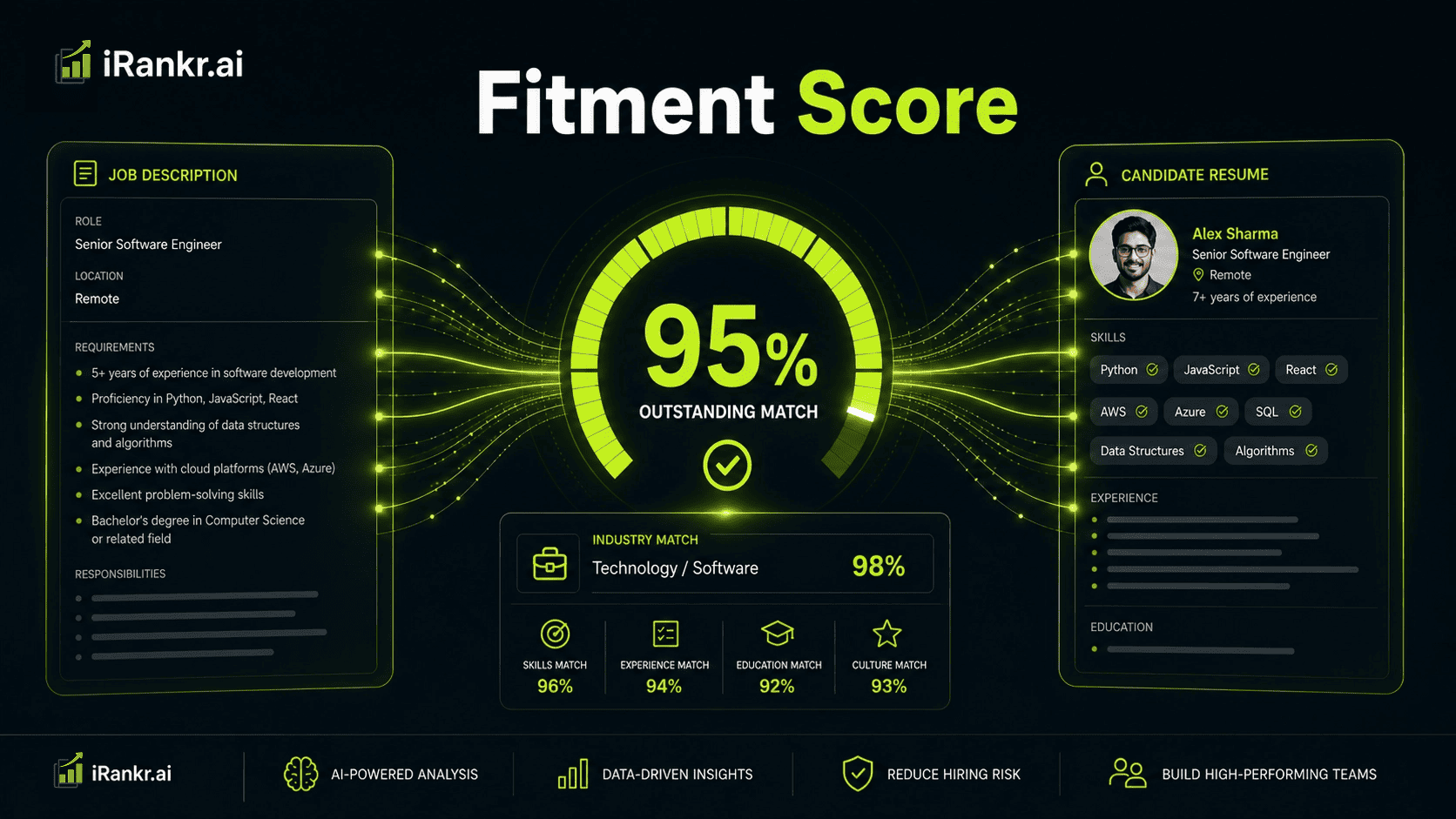
  • What is Fitment Score?

    What is Fitment Score?

    A fitment score answers a question that every recruiter is trying to answer with every resume they read: how well does this specific candidate match this specific role?

    Not “is this a good candidate?” That’s a different, and in many ways less useful, question. A candidate can be excellent – deep experience, strong track record, exceptional references – and still be the wrong fit for a particular role at a particular time. Conversely, a candidate with a less conventional background can be a near-perfect fit for a role that others have struggled to fill.

    Fitment scoring makes this distinction explicit and quantifiable. Here is what it is, how it works, and why it matters more than most of the metrics currently used to evaluate candidates at the screening stage.

    The problem fitment scoring solves

    The traditional resume screening process has no consistent output format. One recruiter puts a candidate in the “yes” pile. Another reads the same resume and puts them in the “maybe” pile. A third reads it on a Friday afternoon and puts them in the “no” pile. None of them is wrong, exactly – they’re all applying judgment. But they’re applying it inconsistently, against an unwritten standard that shifts with every reviewer.

    The result is a shortlist that reflects the screener as much as it reflects the candidates. And a shortlist that reflects the screener rather than objective criteria is a shortlist that the hiring manager has to spend extra time validating, questioning, and often sending back for revision.

    “Fitment scoring replaces this variability with a consistent, role-specific metric. Every candidate evaluated against the same job description gets a score using the same criteria with the same weighting. The candidate at position 1 and the candidate at position 400 are evaluated with identical rigour.”

    What a fitment score measures

    A fitment score is not a measure of candidate quality in the abstract. It is a measure of alignment between a specific candidate profile and a specific role requirement.

    This distinction matters enormously. A senior marketing director with 20 years of experience and an extraordinary track record might score 45% on a fitment assessment for a junior content writer role – not because they’re not a strong professional, but because the role doesn’t call for what they bring. The same candidate might score 96% for a Chief Marketing Officer role at a scaling company. The score is not a judgment of the person. It is a measurement of the match.

    A well-constructed fitment score evaluates alignment across several dimensions:

    Skills alignment – do the candidate’s documented skills match the skills required by the role? This goes beyond keyword matching into semantic evaluation – a candidate who “built payment processing infrastructure” demonstrates financial systems expertise even if they never used the word “fintech” in their resume.

    Experience relevance – is the candidate’s prior experience genuinely applicable to the requirements of this role? Years of experience are a crude proxy here. What matters is whether the nature of the experience – the contexts, the responsibilities, the scale of what they’ve worked on – maps to what the role demands.

    Seniority alignment – is the candidate at the right level for this position? Significant overqualification is as relevant a flag as underqualification. A candidate who is clearly beyond the role’s seniority level represents a hiring risk – they are likely to be unsatisfied and to move on quickly – even if their technical match is high.

    Domain and industry relevance – in roles where sector experience matters, does the candidate’s background reflect the right domain? A B2B sales leader and a B2C sales leader can have similar titles and similar years of experience but very different competencies in practice.

    Role-specific criteria – any requirements specific to the particular role that go beyond general skills and experience. These are defined by the job description and weighted according to their importance.

    How fitment scores are calculated

    Modern AI-powered fitment scoring uses a process that begins with the job description, not with the candidate.

    The system reads the JD – not just the words in it, but the meaning behind them. It identifies what the role requires at a skill level, an experience level, a domain level, and a seniority level. It understands that “led a team” and “managed a group of engineers” mean the same thing, that “developed microservices architecture” implies certain technical competencies whether or not those competencies are listed by name, and that “5+ years in financial services” means something specific about domain exposure rather than just a number and a sector label.

    Once the role profile is built from the JD, the same semantic reading is applied to each candidate’s resume. The system evaluates how closely the candidate’s actual experience, skills, and background match the role profile – not word by word, but meaning by meaning.

    The output is a score, typically expressed as a percentage, that represents the degree of alignment between the candidate’s profile and the role requirements.

    “Most fitment scoring systems allow the weighting of different criteria – you might weight technical skills at 40%, relevant experience at 30%, industry background at 20%, and education at 10% for a particular role. Changing the weighting changes the score, because different roles genuinely prioritise different things.”

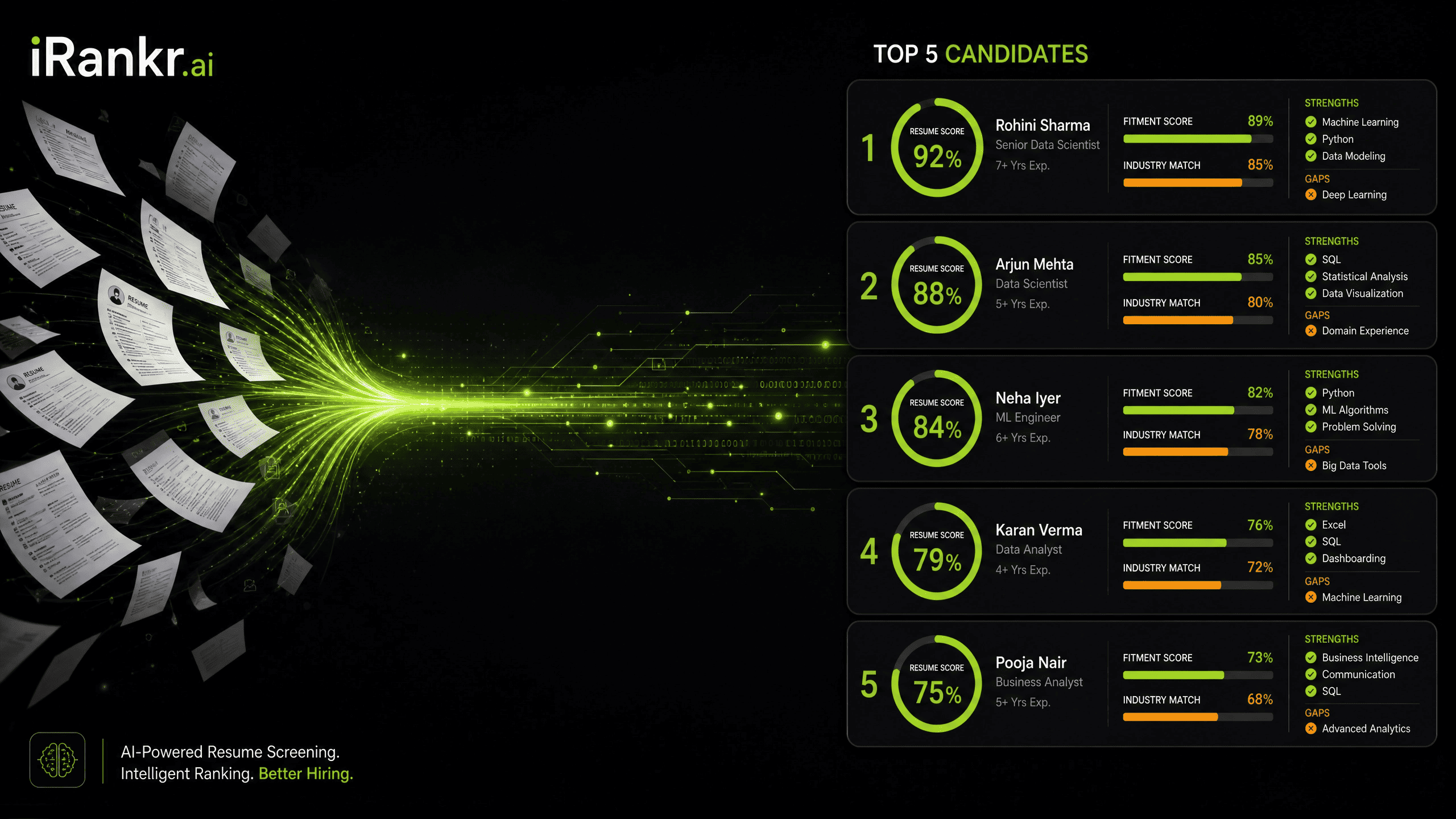
    Upload or paste a JD for an opening, then upload resumes on iRankr and produce a fitment score and an industry match score for every candidate in <2 minutes.

    Save time drastically while maintaining top notch quality levels across your resume screening process: Try running your next high volume project on iRankr for free.

    Try it free for 30 days.

    What fitment score is not

    It is not a replacement for interviewing. A fitment score tells you about the alignment between a candidate’s documented experience and a role’s documented requirements. It says nothing about the candidate’s personality, their working style, their cultural alignment with the team, or the many qualities that only become visible through conversation. Fitment scoring is a screening tool, not a hiring tool.

    It is not a measure of future performance. A high fitment score means the candidate is well-matched to the requirements of the role as described. It does not mean they will definitely succeed in the role. Performance depends on factors that a resume cannot capture – motivation, adaptability, relationships with the team, quality of management, and much else besides.

    It is not infallible. The quality of a fitment score is directly dependent on the quality of the job description it is scored against. A vague JD produces a vague score. A JD that emphasises the wrong criteria produces a score that emphasises the wrong criteria. The score is as good as the rubric.

    It is not a black box – or at least, it shouldn’t be. A fitment score that arrives without explanation is not trustworthy. The score should come with a clear breakdown: which criteria were evaluated, how each one was scored, and what specific evidence from the resume drove the assessment. If a tool gives you a number without showing its working, treat that as a significant red flag.

    The relationship between fitment score and industry match score

    Many AI screening tools, including iRankr, produce two distinct scores: a fitment score and an industry match score. These are not the same thing and are worth understanding separately.

    The fitment score measures alignment across skills, experience, seniority, and role-specific criteria. It answers the question: does this candidate have what the role requires?

    The industry match score measures the relevance of the candidate’s domain background to the hiring organisation’s sector. It answers a different question: has this candidate operated in a context genuinely similar to ours?

    These two scores can diverge in ways that are useful for hiring decisions. A candidate might score 88% on fitment – they have all the right technical skills, the right seniority, the right experience type – but only 52% on industry match, because they’ve worked exclusively in e-commerce and the role is in healthcare. That information changes the hiring conversation. It doesn’t necessarily disqualify the candidate, but it tells the interviewer exactly what to explore: how transferable is their experience? How quickly can they get up to speed on the domain?

    Conversely, a candidate might score 71% on fitment but 94% on industry match – they’re deeply embedded in the right sector but lack one or two technical capabilities the role requires. That’s a training conversation, not a rejection.

    Seeing both scores together gives a more nuanced picture of every candidate than either score alone.

    How to use fitment scores in practice

    Use the score to navigate, not to decide. The fitment score tells you where to look first, not who to hire. Start your review with the highest-scoring candidates. Work down the list. Use the score as a priority queue for your attention, not as an automatic selection mechanism.

    Read the explanation, not just the number. The score is a summary. The explanation is the content. A candidate who scores 82% because of strong skills alignment but weak industry experience is a different proposition from one who scores 82% because of strong industry experience but missing one technical competency. The number is the same. The hiring decision is different.

    Use score gaps to structure interviews. The gaps analysis that accompanies a well-produced fitment score is a ready-made interview brief. If the system flags that a candidate scores low on leadership experience for a team lead role, the interviewer knows to probe for management experience, even if it’s informal or not prominently listed on the CV. Gaps are not automatic red flags – they are conversation starters.

    Don’t use the score in isolation from context. A candidate who scores 76% in a pool where the highest score is 80% is performing very differently from a candidate who scores 76% in a pool where the highest score is 95%. The score should always be read relative to the pool, not in absolute terms.

    Be transparent with your team about what the score means. When you share a shortlist that includes fitment scores, make sure the hiring manager and technical reviewer understand what the score represents – specifically that it measures role alignment, not candidate quality in general. A hiring manager who sees a 76% next to a candidate’s name and interprets it as “this person is 76% good” is misreading the output in a way that can lead to poor decisions.

    Why fitment scoring matters beyond efficiency

    The efficiency argument for fitment scoring is obvious: faster screening, more consistent shortlists, less time spent reading resumes. These are real and significant benefits.

    But the more important argument is about quality, not speed.

    The candidates who are most likely to get lost in a high-volume manual screening process are not the obviously strong ones – they get through every time. They are the unconventional ones: the career changer with genuinely transferable skills, the candidate from a non-traditional educational background whose experience is deep and relevant, the professional who describes their work in language that doesn’t match the JD’s vocabulary but reflects exactly the right capabilities.

    Fitment scoring, done well, finds these candidates. It evaluates what they’ve done and what the role requires at a semantic level, rather than matching their words to the JD’s words. It surfaces the candidate who built fintech-relevant systems at a logistics company, the sales leader whose B2B experience is deeply applicable even though they come from a different sector, the engineer whose open source contributions demonstrate capabilities that never appear on their formal employment record.

    “The best hire for a role is not always the most obvious candidate. Fitment scoring, at its best, is a tool for finding the less obvious ones before they disappear into the pile.”

    iRankr produces a fitment score and an industry match score for every candidate – with a full breakdown of strengths, gaps, and the reasoning behind every score.

    Save time drastically while maintaining top notch quality levels across your resume screening process: Try running your next high volume project on iRankr for free.

    Try it free for 30 days.

  • How to Screen 500 Resumes Fast

    How to Screen 500 Resumes Fast

    500 resumes. One role. A hiring manager who needed a shortlist yesterday.

    This is not an unusual situation for a recruiter at a growing company, a busy recruitment agency, or a staffing team handling multiple client briefs simultaneously. And the standard advice — “be systematic,” “use a scoring rubric,” “read carefully” — does not survive contact with the reality of 500 PDFs sitting in a folder.

    This guide is about what actually works. A practical, honest workflow for screening high volumes of resumes faster without sacrificing the quality of what comes out the other side.

    Why speed and quality feel like opposites — and how to stop treating them that way

    Most recruiters approach high-volume screening as a tradeoff: you can be fast or you can be thorough, but not both. The faster you go, the more you miss. The more thorough you are, the longer it takes.

    This framing is the problem.

    Speed and quality are not opposites in resume screening — inconsistency is the enemy of both. The reason manual screening at volume produces poor results is not that recruiters move too fast. It is that they move at different speeds, with different mental models, at different energy levels, across the same pile of resumes. The candidate at position 1 gets a different quality of attention than the candidate at position 287. That variability is where strong candidates get lost.

    The goal of a high-volume screening workflow is not to read faster. It is to evaluate consistently — to ensure that candidate 287 gets the same quality of assessment as candidate 1, regardless of what time of day it is or how many resumes you’ve already looked at.

    Everything in this guide is oriented toward that goal.

    Before you open a single resume: the setup that determines everything

    The quality of a high-volume screening process is determined before any resume is read. These steps happen once, at the start, and they shape every decision that follows.

    Step 1: Audit the job description before you begin

    The job description is the evaluation rubric. If it is vague, your screening will be vague. If it contains contradictions — asking for 10 years of experience in a technology that has existed for 6 years, for instance, or requiring both “deep technical expertise” and “minimal technical background” — your screening will be inconsistent because different resumes will satisfy different parts of the JD.

    Before screening begins, read the JD specifically looking for:

    • Skills listed as required versus preferred — be clear on which is which before you start
    • Seniority signals — “managed a team” means something different from “worked in a team environment”
    • Industry or domain requirements — is sector experience mandatory or beneficial?
    • Any language that is so generic it provides no screening value — “strong communication skills,” “team player,” “results-oriented” — these should not be factors in your first-pass screening

    If the JD has problems, fix them before screening begins. Twenty minutes spent clarifying the JD saves hours of inconsistent screening downstream and significantly reduces back-and-forth with the hiring manager.

    Step 2: Define your shortlist criteria in writing, not in your head

    Before opening any resume, write down — in a document or even a sticky note — the three to five criteria that a candidate must satisfy to make the shortlist. Not “nice to have.” Must have.

    For a mid-level Java developer role in a fintech company, this might be:

    • Minimum 4 years of Java development experience
    • At least one role in a fintech, payments, or financial services environment
    • Hands-on experience with microservices or distributed systems
    • Currently at the right seniority level (individual contributor, not director)

    These are your gates. A candidate who doesn’t pass all four goes to a separate pile for later review, not automatic rejection. A candidate who passes all four goes into the shortlist pool for deeper evaluation.

    Having these written down before you start means your criteria don’t shift as you go. Resume 1 and resume 400 are evaluated against the same list.

    Step 3: Batch, don’t stream

    If resumes are coming in through an email inbox or job board, resist the urge to screen them as they arrive. Streaming — reading each resume as it lands — creates three problems. You evaluate earlier applicants against a different competitive set than later ones. You create artificial urgency that pushes you toward faster, less careful decisions. And you miss the ability to compare candidates against each other, which is where relative quality becomes visible.

    Instead, set a batching window. For most roles, 24 to 48 hours is enough to let the bulk of applications arrive. Then screen the full batch at once.

    The screening workflow: three passes, not one

    The most effective high-volume screening process uses three passes, each with a different purpose. The first pass is fast and binary. The second is more careful. The third is comparative.

    Pass 1 — The gate check (10–15 seconds per resume)

    First pass is not about quality assessment. It is about gate compliance. Does this candidate meet the non-negotiable criteria you defined in step 2?

    At this stage, you are looking for four pieces of information: relevant experience, approximate seniority level, industry or domain background, and any immediate disqualifying factors. If all four gates are satisfied, the resume moves to the second pass pile. If any non-negotiable is missing, it goes to a separate pile for later review.

    The goal of pass 1 is to reduce 500 resumes to a manageable subset — typically 50 to 100 — that genuinely deserve deeper attention. If pass 1 is producing fewer than 10% survival rate, your gates may be too strict. If it is producing more than 40%, either the job board is very well-targeted or your gates are too loose.

    Pass 2 — The quality assessment (2–3 minutes per resume)

    Second pass is where actual evaluation happens. You are now reading the resumes that passed the gate check with genuine attention — looking for the quality of experience, not just its presence.

    At this stage you are asking: how relevant is the experience, not just whether it exists? A candidate with 5 years of Java experience at a single company doing the same work for 5 years is a different proposition from a candidate with 5 years of Java experience across three different contexts, each one increasing in complexity. Both pass the gate check. Second pass distinguishes them.

    Score each candidate on your defined criteria — a simple 1-3 scale per criterion is enough. The total gives you a rough rank ordering that informs the third pass.

    Pass 3 — The comparative review and shortlist decision (30 minutes total)

    Third pass is not about individual resumes. It is about the shortlist as a set. You are reviewing the candidates who scored highest in pass 2 and making comparative decisions: given this specific hiring manager, this specific team, and this specific role, which of these candidates represents the strongest slate to put forward?

    This is the stage where human judgment is most valuable and least replaceable. The AI or the structured process got you here. The decision about who to call first is yours.

    Where AI changes this workflow

    The three-pass process described above is the best manual approach to high-volume screening. But it is still manual — and it has the same structural weakness that all manual processes have: it is only as consistent as the person running it, and it is only as fast as they can read.

    AI resume screening does not replace this workflow. It replaces pass 1 and most of pass 2 with a machine process that is faster, more consistent, and operates without fatigue.

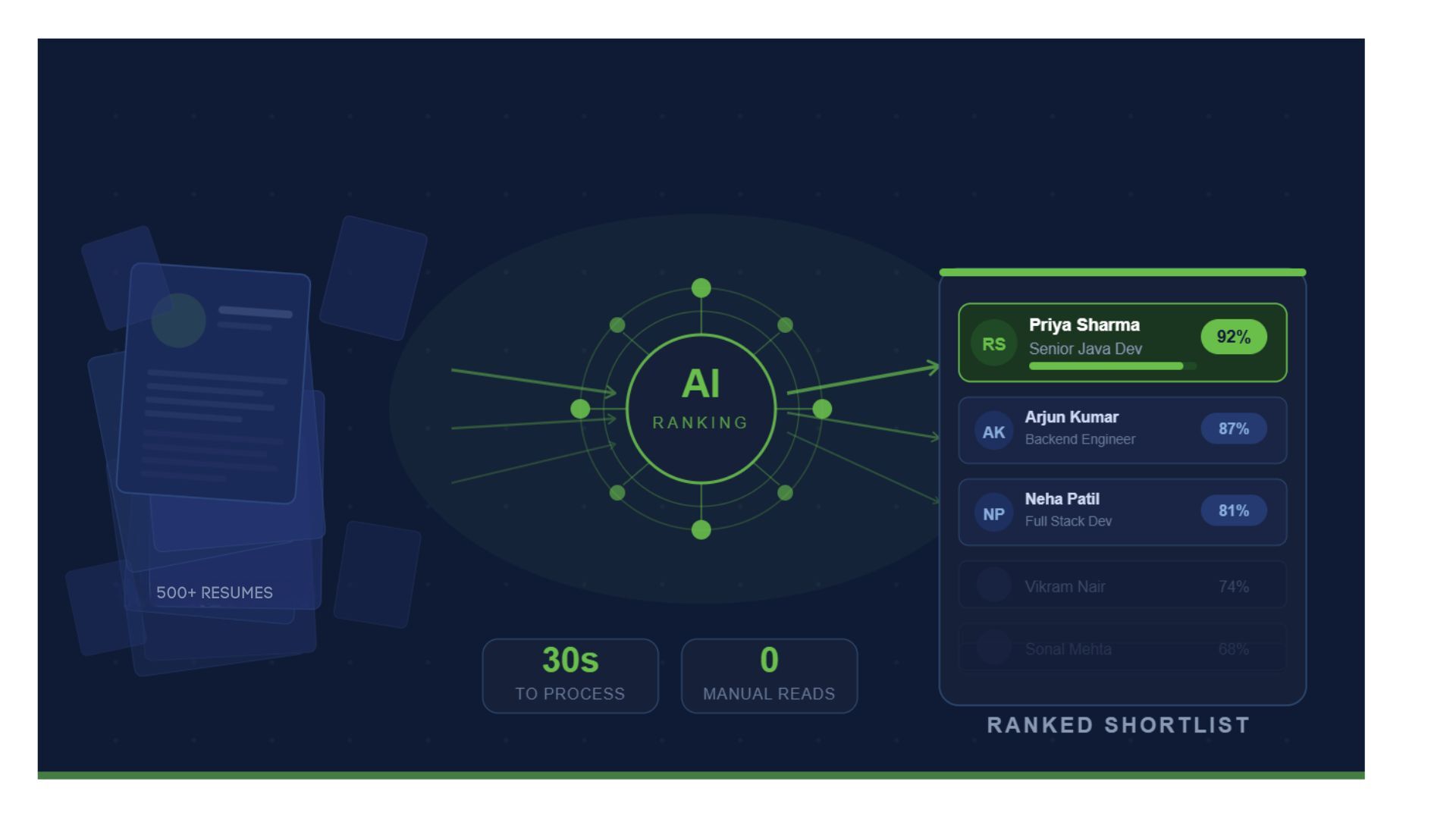
    The practical difference: instead of spending 10–15 seconds per resume on 500 resumes for pass 1 (that’s 80 to 125 minutes just for the gate check), you upload all 500 and get a ranked, scored list with explanations in minutes. Pass 1 and pass 2 are effectively combined and accelerated. You spend your time on the comparative review — pass 3 — which is where your judgment actually adds value.

    For a role receiving 500 resumes:

    StageManual processWith AI screening
    JD audit and criteria definition20 minutes20 minutes (unchanged)
    Organising and opening the pile30-45 minutes5 minutes (upload)
    Pass 1 — gate check90-120 minutes5-10 minutes (processing + review output)
    Re-opening, re-checking, losing your place20-40 minutes0 minutes
    Pass 2 — quality assessment100–150 minutes20–30 minutes (reviewing AI output)
    Pass 3 — comparative review30 minutes30 minutes (unchanged)
    Total300–375 minutes5-6.2580–95 minutes1.3-1.6

    “The time saving on a 500-resume role is about 5 hours. Across multiple concurrent roles, that saving compounds significantly.”

    But the time saving, while real, is only half the story.

    The more significant change is what happens to the quality of your shortlist.

    When you screen 500 resumes manually, candidate 1 and candidate 287 do not receive the same evaluation. By resume 150, you are running on pattern recognition rather than structured assessment. The bar has quietly moved. Strong candidates who appear later in the pile – or who describe their experience in language slightly different from the JD – get filtered out not because they’re unsuitable, but because the evaluation ran out of rigour before it reached them.

    AI screening applies the same criteria to every candidate with identical rigour. It doesn’t lose its place. It doesn’t lower the bar at resume 300.

    For a single HR manager running one or two roles a month, the hours saved matter less than this: how many times has your best candidate been somewhere in that pile – and not made the shortlist – simply because of where they happened to appear in the queue?

    AI screening doesn’t just make you faster. It makes your shortlist more accurate. For many teams, that second benefit has more impact on hiring quality than the first.

    Save time drastically while maintaining top notch quality levels across your resume screening process: Try running your next high volume project on iRankr for free.

    Try it free for 30 days.

    Common mistakes that slow you down and cost you candidates

    Screening in order of arrival. The first resumes to arrive are not the best resumes. They are simply the fastest. Screening in arrival order creates a false sense of momentum and biases toward candidates who apply immediately rather than candidates who are genuinely strongest.

    Using the same JD language as your screening criteria. If your JD says “Python developer” and you screen for the exact phrase “Python,” you will miss candidates who describe the same capability in adjacent language. Screen for competence, not vocabulary.

    Making rejection decisions on pass 1. Pass 1 should produce a “maybe” pile and a “strong maybe” pile — not a rejection pile. Resumes that don’t make the shortlist at pass 1 should be held, not discarded. Hiring managers change requirements. Roles evolve. The candidate who didn’t quite fit this brief might be exactly right for the one that opens next month.

    Screening alone when team screening is available. Two recruiters independently screening the same pass-2 pile and then comparing notes produces a better shortlist than one recruiter screening alone. Disagreements reveal either genuine ambiguity in the criteria or genuine difference in how the role is being interpreted — both of which need to be resolved before the shortlist goes to the hiring manager.

    Not tracking what you’re finding. If you screen 500 resumes and 480 fail at pass 1 because of the same missing criterion — say, no fintech experience — that is information the hiring manager needs. Either the talent market doesn’t have what they’re looking for at the specified seniority and salary, or the JD needs to be revised. Feeding this intelligence back into the sourcing and requirements conversation is part of the recruiter’s value-add.

    The shortlist that gets approved first time

    The final output — the shortlist you send to the hiring manager or technical reviewer — is the product of all of this work. How you present it determines whether it gets approved quickly or sent back with questions.

    A strong shortlist presentation includes, for each candidate:

    • A one-paragraph summary of why they are on the list — not their full career history, but the specific reasons they fit this role
    • The two or three things that make them particularly strong for this position
    • The one or two things that are missing or uncertain, and what to probe in the interview
    • A suggested interview focus based on what the CV reveals and what it doesn’t

    This level of context takes 5 minutes per candidate to write if you have been screening consistently. It saves 30 minutes of back-and-forth with the hiring manager who would otherwise have to read the full CVs themselves to understand why these ten people are on the list.

    If you are using AI screening, most of this context is generated automatically as part of the scoring output — the strengths summary and gaps analysis for each candidate are already there. Your job is to validate, adjust, and present.

    When high volume is simply the reality

    500 applications is not unusual. For any role with a recognisable brand behind it or a well-distributed posting, it is the normal outcome of recruiting done properly.

    The instinct to treat volume as a problem – stricter filters, faster rejection thresholds – typically makes things worse. Keyword filters reduce the pile but introduce a different error: filtering out candidates who would have been strong but didn’t match the JD’s exact vocabulary.

    The right response to high application volume is not to see less of it. It is to evaluate all of it without quality degrading as the pile grows.

    That is what AI screening is built for. When every resume in a 500-application pool receives the same structured assessment regardless of where it sits in the queue, volume stops being a source of stress and becomes a competitive advantage. More applications means more signal – and a better chance of finding the right person, provided the evaluation system can handle the signal consistently.

    The recruiter who can evaluate 500 resumes with the same rigour they’d apply to 50 isn’t just more efficient. They’re making better hiring decisions than the recruiter who filtered down to 50 and hoped the right person made it through.

    iRankr screens and ranks your full resume pool – be it 50 or 500 – against your job description in minutes, with explainable fitment scores for every candidate.

    Try it free for 30 days.

  • What is AI Resume Screening?

    What is AI Resume Screening?

    If you’ve spent a morning reading through 200 resumes for one role, you already understand the problem that AI resume screening was built to solve.

    The question most recruiters have isn’t whether something needs to change — it’s whether AI is actually the answer, or whether it’s just the latest technology trend being sold to an industry that’s been burned by overpromised tools before.

    This guide answers that question honestly. What AI resume screening actually is, how it works under the hood, what it doesn’t do, and how to know whether a tool is worth trusting with your hiring process.

    The challenge: Manual screening

    Manual resume screening has three fundamental problems that no amount of effort or experience fully solves.

    Volume. A mid-level role at a growing company routinely attracts 150 to 300 applications. A popular role at a well-known brand can attract thousands. No human being can read 300 resumes with consistent attention and rigour. By resume 80, cognitive fatigue has set in. By resume 150, you’re pattern-matching off exhaustion rather than criteria.

    Consistency. Two recruiters screening the same 50 resumes against the same job description will produce meaningfully different shortlists. Not because one is better than the other — because manual screening is inherently subjective. The first resume sets a benchmark that shifts as the pile grows.

    “A candidate who would have made the cut at resume 15 might not make it at resume 115, not because they’re less qualified but because something stronger came between them.”

    Retrieval. Most organisations have years of accumulated candidate data — resumes from previous roles, candidates who were strong but not right for that particular position, profiles that arrived at the wrong time. Almost none of this data is actively used. When a new role opens, the search starts from scratch — job boards, LinkedIn, new applications — while the right candidate from eight months ago sits invisible in a shared drive.

    AI resume screening addresses all three of these problems. It doesn’t address them perfectly, and it doesn’t replace human judgment. But it addresses them in ways that manual screening structurally cannot.

    What AI resume screening actually is

    AI resume screening is the process of using artificial intelligence to automatically evaluate, score, and rank a pool of resumes against a specific job description — without a human reading each one individually first.

    “The key word in that definition is score. Good AI screening doesn’t just filter resumes into yes and no piles. It produces a ranked list with a score for every candidate, along with the specific reasons behind that score. The recruiter then reviews the top-ranked candidates — not all of them.”

    This is the fundamental workflow shift: instead of reading 200 resumes to find 10 worth interviewing, you read the AI’s assessment of all 200 and validate the top 10. The reading work is done by the machine. The judgment work — deciding who to call, what to probe, how to weigh one strength against another — stays with you.

    How it works: the difference between old and new

    To understand what modern AI screening does, it helps to understand what it replaced.

    Traditional ATS keyword matching — the system most organisations have been using for 20 years — works like a search engine from 2003. It scans resumes for the presence of specific words or phrases from the job description. If the JD says “Python” and the resume says “Python,” the candidate passes. If the JD says “Python” and the resume says “I built data processing pipelines using scripting languages,” the candidate fails — even though they’ve described the same capability in different words.

    This approach has two well-documented problems. It filters out qualified candidates who express their experience in non-standard language, and it lets through candidates who have learned to stuff their resume with the right keywords regardless of actual depth of experience.

    Modern AI resume screening uses a fundamentally different approach. Instead of matching words, it matches meaning.

    The AI reads the job description and understands what the role actually requires — not just the words used to describe it, but the underlying skills, experience level, domain context, and seniority signals. It then reads each resume with the same understanding, evaluating what the candidate has actually done and comparing it to what the role actually needs.

    A candidate who built payment systems at a logistics company gets recognised as fintech-relevant, even if “fintech” never appears in their resume. A candidate who lists “leadership” as a skill but has never managed anyone gets scored lower than one who describes building and mentoring a team, even if the latter never used the word “leadership.”

    This is what is meant by semantic understanding — the AI evaluates meaning, not vocabulary.

    What a good AI screening output looks like

    The output of AI resume screening should never be just a number. A score without explanation is a black box, and a black box is not something you should be trusting with your hiring decisions.

    A well-designed AI screening output includes four things for every candidate:

    A fitment score — a composite measure of how well the candidate matches the specific role requirements. Not a generic “candidate quality” score, but a role-specific evaluation. The same candidate might score 91% for a mid-level Java developer role and 43% for a senior engineering manager role. The score reflects the match, not the person.

    An industry match score — a separate evaluation of whether the candidate’s domain background is genuinely relevant to the hiring organisation’s sector. This matters particularly for roles where industry experience is non-negotiable — a BFSI compliance officer role is fundamentally different from a compliance role in a pharmaceutical company, even if the job title is identical.

    A strengths summary — the specific things the candidate brings to this role. Not generic strengths, but role-specific ones. “8 years of Java microservices experience across two fintech companies, with team leadership at the most recent role” is useful. “Strong technical background” is not.

    A gaps analysis — the specific ways in which the candidate falls short of the role requirements. This is as important as the strengths, because it tells the interviewer exactly what to probe, and it gives the hiring manager honest context for each shortlisted profile.

    “If an AI screening tool produces only a score with no explanation, treat that as a warning sign.”

    iRankr provides a fitment score, an industry match score, a strengths summary and a gaps analysis for all shortlisted candidates.

    iRankr provides a fitment score, an industry match score, a strengths summary and a gaps analysis for all shortlisted candidates.

    Try it free for 30 days.

    What AI resume screening does not do

    This is important enough to address directly, because a lot of the scepticism about AI in hiring comes from conflating what the technology actually does with what some vendors have overclaimed.

    It does not make hiring decisions. AI screening surfaces and ranks candidates. Every decision to advance, reject, or interview a candidate remains with the recruiter or hiring manager. The AI produces a structured starting point for human judgment — it does not replace it.

    It does not conduct interviews. Some tools do this — AI-driven video or voice interviews with automated scoring. That is a separate category of technology with its own distinct considerations. Resume screening AI reads documents, not people.

    It does not eliminate bias. This is the most important caveat. AI can reduce some forms of bias — specifically the fatigue bias and ordering effects that affect manual screening — by evaluating every candidate against the same criteria with the same rigour. But AI can perpetuate or amplify other forms of bias if it is trained on historical hiring data that reflects past discriminatory patterns, or if the job description it’s given contains biased language.

    “A good AI screening tool is bias-aware and transparent about this. A bad one pretends the problem doesn’t exist.”

    It is not a replacement for a strong recruitment process. AI screening is a first-pass tool. It improves the efficiency and consistency of the screening stage. It does not improve the quality of your interviews, the accuracy of your offer decisions, or the effectiveness of your onboarding. It solves one problem in the pipeline — an important one, but one.

    Who benefits most from AI resume screening

    AI resume screening adds the most value in specific contexts:

    High-volume roles — any position that regularly attracts more than 50 applications. Below 50 resumes, manual screening is manageable. Above 50, the quality of manual screening begins to degrade in ways that AI can structurally prevent.

    Teams screening simultaneously across multiple roles — a recruiter managing 6 open positions cannot give each one the manual attention it deserves. AI screening means every role gets a consistent, rigorous first pass regardless of how many are running in parallel.

    Organisations with historical candidate databases — any team that has been collecting resumes for more than a year has a talent pool that manual search cannot effectively access. AI-powered candidate rediscovery turns an archive into an active resource.

    Staffing and recruitment agencies — where turnaround time on client submissions is directly linked to revenue, and where a structured, explainable shortlist is a competitive differentiator in client relationships.

    Growing companies where hiring pace has outpaced team size — where the alternative to AI screening is either hiring more recruiters or accepting lower shortlist quality.

    How to evaluate an AI resume screening tool for your recruiting

    Not all AI screening tools are equal. Here is what to look for:

    Explainability — can the tool tell you why a candidate scored the way they did? If the answer is no, or if the explanation is vague, the tool is not trustworthy enough to use as a screening layer.

    Role specificity — does the tool score candidates against your specific job description, or against a generic notion of candidate quality? The former is useful. The latter is not.

    Semantic understanding — does the tool match keywords or meaning? Ask the vendor directly: how would your tool score a candidate who has the right experience but describes it in non-standard language? The answer tells you everything about the underlying technology.

    Bias transparency — does the vendor discuss bias openly? What steps have they taken to reduce bias in their scoring model? A vendor who dismisses the bias question has not thought carefully enough about what they’re selling.

    Data security — candidate data is sensitive. Where is it stored? Who has access? Can you delete individual candidate records? Is private deployment an option for organisations with strict data requirements?

    Integration with your existing workflow — does it work well with or without an ATS? Can it read from your recruitment inbox automatically? Does it require a change in how your team works, or does it sit on top of what you already do?

    The bottom line

    “AI resume screening is not magic, and it is not a threat to the recruiter’s role. It is a precision tool for a specific, well-defined problem: evaluating large numbers of resumes consistently, quickly, and with enough structure that the results are explainable and defensible.”

    Used well, it gives recruiters back the time and mental energy they’ve been spending on reading — and redirects that capacity toward the work that genuinely requires human skill: building relationships, exercising judgment, and making the calls that determine whether a hire succeeds.

    The question is not whether AI screening works. The question is whether the specific tool you’re evaluating does it in a way that’s transparent, accurate, and honest about what it can and cannot do.

    iRankr is an AI resume screening and candidate ranking tool built for recruiters, recruitment and staffing agencies, and in-house HR teams.

    iRankr is an AI resume screening and candidate ranking tool built for recruiters, recruitment and staffing agencies, and in-house HR teams.

    Try it free for 30 days. No credit card required.